What Is Jev? TypeSafe AI’s Decision Model Explained for Lawyers
Explains a model built for structured decisions and considers how a law firm could test its accuracy, privacy, and limits before using it in a workflow.
Ideas on the page
From legal technology articles to Infinite Counsel, I write about how new tools change the work of lawyers—and the decisions that still call for human judgment.
Explore the publications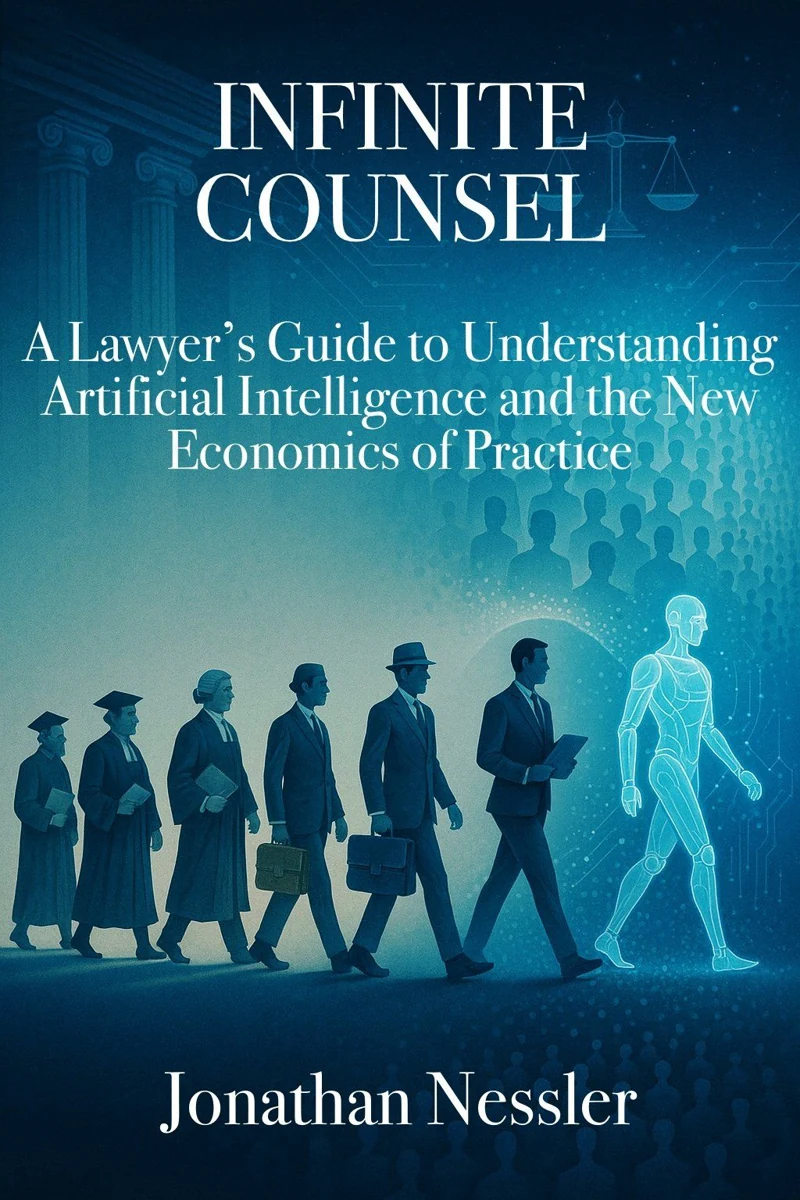
01 The book
A Lawyer’s Guide to Understanding Artificial Intelligence and the New Economics of Practice
What happens to legal work when an intelligent system can complete familiar tasks in minutes? The book begins with how generative AI works and where its answers can fail. It then follows the implications into research, drafting, discovery, confidentiality, staffing, pricing, and client service.
The central question is practical: as the tools become more capable, where does a lawyer’s value come from? Infinite Counsel examines that question from the perspective of someone who has practiced law since 2007.
Published by Integrated Cognition, LLC. Purchase and format options are provided on the publisher’s site.
02 The throughline
The subjects of these publications have changed with the tools available to lawyers. An early article focused on keeping up with relevant technology. Later writing considered connected devices, biometric data, decentralized organizations, and generative AI.
Together, they mark an ongoing interest in what lawyers need to understand before they can use technology responsibly. The archive links to the publisher’s pages and a verified copy of the committee report where those works can be read in context.
03 Articles & contributions
A selection with original publication dates. Later updates and ISBA reprints are labeled separately. For the complete collection of current essays and guides, visit the Integrated Cognition article index.
Explains a model built for structured decisions and considers how a law firm could test its accuracy, privacy, and limits before using it in a workflow.
On permissions, oversight, and accountability when an AI agent can take actions through connected services.
A dated look at new model capabilities and the evidence, permissions, and review needed to supervise AI agents in professional work.
Considers how AI could change law firm pricing, staffing, lawyer training, and client expectations.
Explores legal research and drafting in AI-assisted workflows, with attention to a lawyer’s judgment and responsibility. Updated September 6, 2026.
Traces the rise of hourly billing and asks how AI-driven efficiency could change law firm pricing. Updated September 6, 2026.
On why understanding AI matters for legal work, client service, and professional judgment.
Article published in Trial Journal magazine. A public publisher URL was not available for this print piece.
An introduction to blockchain and smart contracts for Illinois lawyers, published by the ISBA Standing Committee on Legal Technology.
Prepared by an ad hoc ISBA committee on artificial intelligence with Jonathan listed among its members. The report is dated September 27, 2023; the linked PDF is its December 2023 newsletter publication.
An early look at how generative AI could affect legal writing and the practice of law. Republished in The Globe, January 2023 ↗
An overview of decentralized autonomous organizations, published by the ISBA Standing Committee on Legal Technology.
Published by the ISBA Standing Committee on Law Office Management and Economics. Republished in Legal Technology, November 2021 ↗
On connected devices and the questions they raise for law firms. Republished in Business Advice and Financial Planning, July 2019 ↗ Republished in Legal Technology, February 2022 ↗
An article on lawyers’ need to keep up with technology relevant to their work, published by the ISBA Standing Committee on Law Office Management and Economics.
ISBA article links open on the publisher’s site and may require membership. The 2023 committee report opens as a PDF copy hosted by Bellas & Wachowski.

04 About the author
Jonathan T. Nessler is a trial lawyer in Springfield, Illinois, and the founder of Integrated Cognition. His legal practice and work with AI inform his writing about technology, professional responsibility, and the future of legal work.